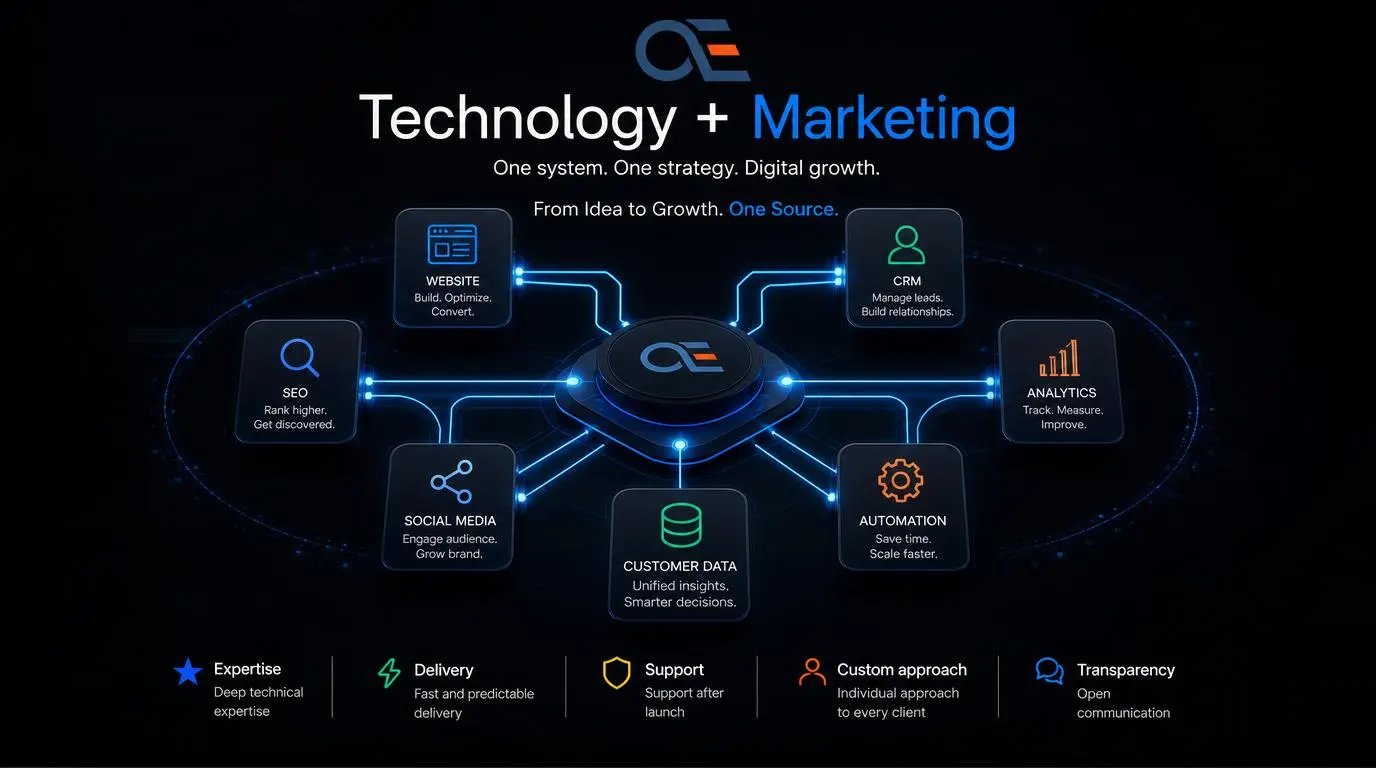
In modern business, technology and marketing are no longer separate worlds.
A website is not just a digital presence.
A CRM is not just a customer database.
Analytics is not just a collection of numbers.
SEO is not just about search rankings.
Social media is not just about publishing content.
Automation is not just about saving a few clicks.
Each of these elements can become part of one connected digital ecosystem.
When technology and marketing work together, businesses can create a more consistent customer experience, improve operational efficiency, and build a stronger foundation for digital growth.
Technology provides the foundation
Every digital marketing strategy depends on technology.
A website needs reliable infrastructure and a clear user experience. A CRM needs to organize customer information. Analytics needs to collect meaningful data. Automation needs systems that can communicate with each other.
Without the right technical foundation, marketing activities can become disconnected.
For example, a business may generate leads through its website and social media, but if those leads are not properly captured in a CRM, followed up, and analyzed, valuable opportunities can be lost.
Technology creates the infrastructure that allows these processes to work together.
Marketing connects the business with its audience
Technology provides the foundation, but businesses still need to reach the right people.
Marketing helps businesses understand their audience, communicate their value, build awareness, generate demand, and develop relationships with customers.
SEO can help potential customers discover a business through search.
Social media can create awareness and engagement.
Content can educate potential customers and build trust.
Digital advertising can reach specific audiences.
Email and CRM campaigns can support ongoing customer relationships.
These activities become more effective when they are connected to the underlying technology.
Data connects decisions with reality
Technology and marketing generate data.
Website analytics can show how visitors interact with a website.
CRM data can provide insight into leads and customers.
Marketing platforms can show which campaigns and channels generate engagement.
Sales data can help identify which activities contribute to actual business results.
The value is not simply in collecting this information.
The real value comes from using it to understand what is working, what is not, and where improvements can be made.
Data creates a feedback loop between marketing activity and business decisions.
From separate tools to one digital ecosystem
Many businesses use different tools for different functions.
One platform manages the website.
Another manages the CRM.
Another handles email marketing.
Another provides analytics.
Social media platforms operate separately.
Accounting or internal business systems may use completely different software.
The challenge is not necessarily having multiple tools.
The challenge is when those tools cannot communicate effectively.
A connected digital ecosystem allows information to move between systems and processes to work together.
For example:
Website → CRM → Automation → Marketing → Analytics → Business Decisions
A website generates a lead.
The CRM records it.
Automation triggers the next step.
Marketing supports communication.
Analytics measures the result.
The business uses the data to improve the process.
This creates a continuous digital growth cycle.
Why integration matters
When technology and marketing operate separately, businesses may face duplicated work, fragmented data, slower processes, and limited visibility.
Integration can help create a more unified approach.
It can allow businesses to:
Connect customer data across systems
Automate repetitive marketing and operational tasks
Track customer journeys
Measure campaign performance
Improve lead management
Personalize communication
Identify opportunities for optimization
Make decisions based on real business data
The goal is not to use more technology.
The goal is to make the technology already used by the business work together more effectively.
A more complete approach to digital growth
Digital growth is rarely driven by a single tool.
A website alone is not a complete digital strategy.
Marketing alone cannot solve operational problems.
Technology without a clear business and marketing strategy may not create meaningful results.
The real opportunity is in connecting these areas.
Technology provides the infrastructure.
Marketing connects the business with its audience.
Data shows what is happening.
Automation improves processes.
Together, they create a more connected approach to digital growth.
Technology + Marketing
Modern businesses need more than isolated digital tools.
They need systems that communicate, data that can be understood, and strategies that connect technology with business objectives.
At One Source IT, we combine technology and marketing to help businesses create, digitize, manage, and grow — from websites and CRM systems to automation, analytics, SEO, social media, and custom digital solutions.
Technology + Marketing = A More Complete Approach to Digital Growth.
Comments
No comments yet. Be the first to comment!
Leave a comment