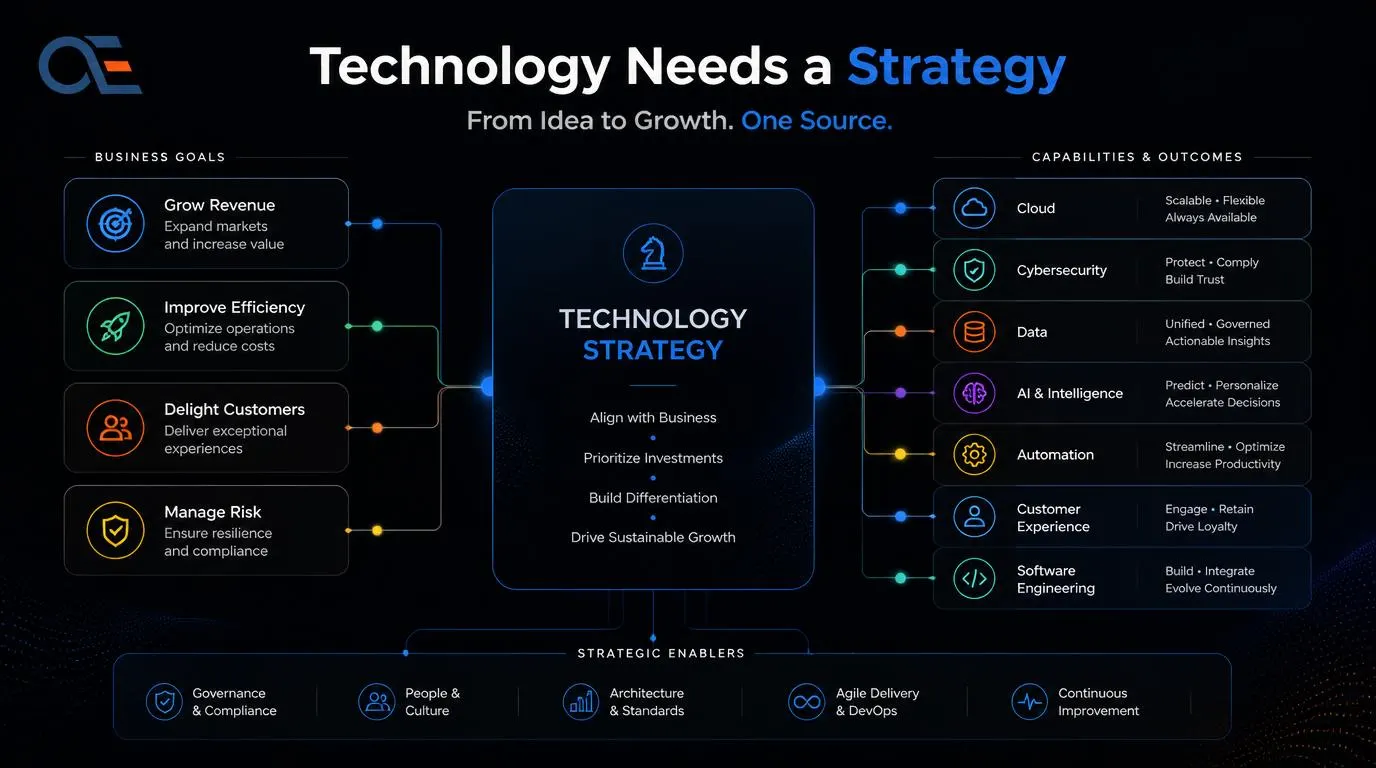
Technology Strategy: How to Choose the Right Solutions for Business Growth
Technology has become an essential part of modern business. Companies use websites, CRM platforms, cloud infrastructure, automation tools, analytics, and artificial intelligence to improve their operations and serve customers more effectively.
However, adopting more technology does not automatically lead to better results.
A new system may introduce unnecessary complexity. An automation tool may optimize a process that should have been redesigned first. Separate platforms may create data silos instead of improving collaboration.
The real challenge is not finding more technology. It is identifying which technologies can solve actual business problems and contribute to long-term growth.
That is why every effective technology decision should begin with a strategy.
Why Technology Needs a Clear Strategy
Without a clear direction, businesses often make technology decisions reactively. They purchase software because competitors use it, adopt new tools because they are trending, or invest in infrastructure without considering future requirements.
These decisions can lead to higher costs, disconnected systems, security vulnerabilities, and limited business value.
A technology strategy connects business objectives with the tools, systems, and infrastructure needed to achieve them.
It helps businesses determine:
Which problems should be addressed first.
Which processes would benefit from automation.
Where artificial intelligence can deliver measurable value.
Which systems need to communicate with one another.
How infrastructure should evolve as the company grows.
What security risks must be addressed.
Which investments should be prioritized.
The goal is not to use every available technology. It is to build a reliable, efficient, and scalable technological foundation for the business.
1. Start With Business Problems, Not Technology
Before selecting a solution, a business needs to understand what it wants to improve.
Is the team spending too much time on repetitive administrative work? Are customer requests being missed? Is sales information scattered across different spreadsheets? Are employees manually transferring data between systems?
These are business problems. Technology becomes valuable when it helps solve them.
For example, a company experiencing delays in customer communication might benefit from a CRM system with automated follow-ups and centralized customer information. A business struggling with manual reporting might need integrated data sources and automated dashboards rather than another standalone application.
The right solution depends on the problem, the existing processes, and the expected outcome.
A useful starting point is to define the problem, identify its impact, and establish what a successful result should look like.
2. Identify Processes That Should Be Automated
Automation can reduce repetitive work, minimize manual errors, and allow employees to focus on tasks that require human judgment.
However, not every process should be automated immediately.
Businesses should first examine how their workflows operate, where delays occur, and which activities consume the most time.
Potential automation opportunities include:
Processing incoming customer requests.
Assigning leads to sales representatives.
Sending notifications and follow-up messages.
Generating recurring reports.
Managing invoices and documents.
Synchronizing information between business systems.
Updating customer records.
Coordinating internal approvals.
Automation works best when the underlying process is clearly defined. Automating an inefficient workflow without reviewing it first may simply make the existing problems happen faster.
The objective should be to simplify operations, improve consistency, and create measurable improvements in productivity.
3. Understand Where AI Can Create Real Value
Artificial intelligence is expanding the possibilities for business automation and decision support. Yet AI should not be introduced simply because it is popular.
The key question is whether it can solve a specific problem more effectively than the existing approach.
AI may help businesses analyze large volumes of data, classify documents, support customer service, summarize information, assist sales teams, generate content, or process incoming requests.
For example, an AI-powered support workflow might classify a customer inquiry, identify relevant information, prepare a response, and route the request to the appropriate team.
In another scenario, AI could extract information from documents and transfer it into a business system, reducing manual data entry.
However, AI solutions also require appropriate data, clear workflows, access controls, and human oversight where necessary.
Successful AI adoption begins with a practical use case and a measurable business objective — not with the technology itself.
4. Connect Systems Instead of Creating Silos
As businesses grow, they often introduce new platforms for sales, marketing, finance, customer support, and operations.
When these systems operate independently, employees may need to enter the same information multiple times, reports may contain inconsistent data, and teams may lack a complete view of business activity.
System integration helps different applications exchange information and work together.
For example, a website inquiry can be transferred directly into a CRM. The CRM can assign the lead to a sales representative, trigger a notification, and record the next action. Relevant information can then be made available to reporting and analytics tools.
A well-integrated environment can help businesses:
Reduce duplicate data entry.
Improve information accuracy.
Accelerate internal workflows.
Provide better customer experiences.
Improve reporting and visibility.
Reduce unnecessary manual work.
Integration should be planned around actual business processes, data requirements, and security considerations. Connecting systems without a clear architecture can create additional complexity rather than eliminate it.
5. Build Infrastructure That Can Scale
Technology must support the business as it grows.
A solution that works well for a small team may become difficult to manage when the company expands, transaction volumes increase, or new services are introduced.
Infrastructure planning should consider performance, availability, backup and recovery, monitoring, access management, and future capacity.
Depending on business requirements, the right approach may involve cloud services, on-premises infrastructure, or a hybrid environment.
Scalability does not necessarily mean choosing the largest or most expensive architecture from the beginning. It means making informed decisions that allow the business to expand without unnecessary disruption or excessive cost.
A scalable foundation should support current operations while leaving room for future requirements.
6. Include Cybersecurity in Every Technology Decision
Security should not be treated as a separate project that begins after implementation.
New applications, integrations, cloud environments, and automation workflows can introduce risks if access, data protection, and monitoring are not considered from the start.
A technology strategy should address:
Who can access systems and sensitive information.
How user identities and permissions are managed.
How business data is protected and backed up.
How software and infrastructure are updated.
How suspicious activity is detected.
How the business can recover from an incident.
How third-party services and integrations are evaluated.
Security requirements should match the nature of the business, the sensitivity of its data, and its operational risks.
Integrating security into the planning stage is generally more effective than trying to correct major weaknesses after systems are already in use.
7. Prioritize Investments and Measure Results
A technology strategy should help businesses make better investment decisions, not simply produce a list of tools to purchase.
Each proposed solution should be evaluated against its expected business impact, implementation effort, operating costs, risks, and long-term value.
Useful performance indicators may include:
Time saved through automation.
Reduction in manual errors.
Customer response and processing times.
Sales pipeline visibility.
System availability and reliability.
Cost per transaction or business process.
Adoption and usage by employees.
Not every benefit can be measured immediately, but defining success criteria before implementation makes it easier to evaluate whether a solution is delivering value.
Businesses can also reduce risk by starting with a focused pilot, reviewing the results, and expanding only when the solution proves useful.
Technology Strategy Is an Ongoing Process
A technology strategy is not a document that is written once and forgotten.
Business objectives change. Customer expectations evolve. New risks emerge. Technologies improve, and existing systems may eventually become unsuitable.
Regular reviews help businesses keep their technology aligned with their goals and identify opportunities for improvement.
The most effective strategy balances immediate operational needs with long-term flexibility. It avoids unnecessary complexity while ensuring that essential systems remain reliable, secure, and ready to support growth.
How One Source IT Approaches Technology Strategy
At One Source IT, we believe effective technology decisions start with understanding the business.
Before recommending a solution, it is important to understand the company's objectives, existing processes, infrastructure, challenges, and future plans.
This approach helps connect technology with real operational needs — from website and software development to CRM implementation, business automation, AI solutions, infrastructure, cybersecurity, and digital transformation.
The objective is not simply to introduce new tools. It is to create a technology environment that works together, supports the team, and contributes to sustainable business growth.
Final Thoughts
Businesses do not necessarily need more technology. They need technology that solves the right problems, supports their operations, and prepares them for what comes next.
When business goals guide technology decisions, every investment has a clearer purpose and every solution has a better chance of delivering meaningful results.
Business Goals → Technology Strategy → The Right Solutions
Technology creates the greatest value when it is chosen with purpose.
Comments
No comments yet. Be the first to comment!
Leave a comment