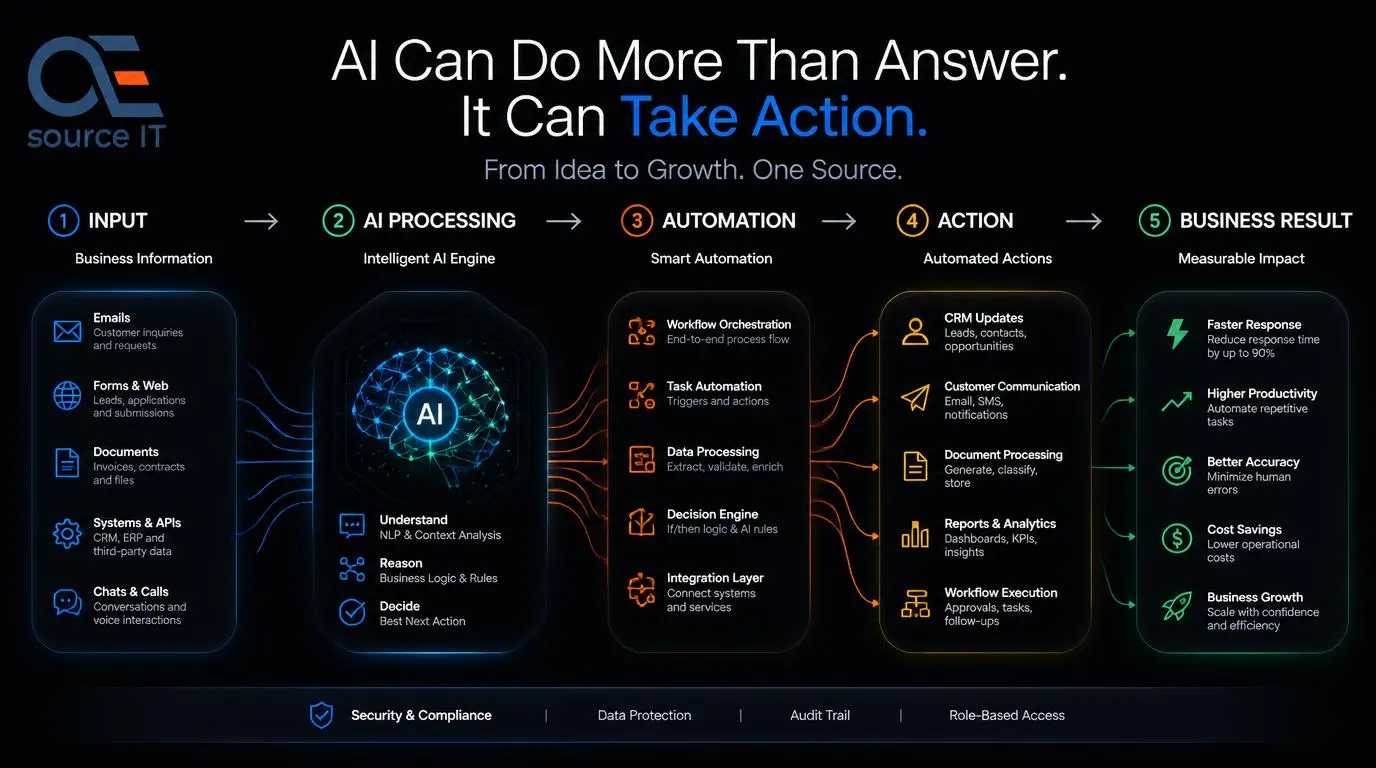
AI Is Already Changing Business Operations
Artificial Intelligence is often described as a technology that will transform the future. However, that transformation is already happening.
Businesses are beginning to integrate AI into everyday operations to reduce manual work, process information faster, improve customer interactions, and support better decision-making.
From small businesses looking to save time to growing companies managing complex workflows, AI offers new ways to improve how work gets done.
The important shift is that AI is no longer limited to experimentation or technical research. It is becoming a practical tool for solving real business challenges.
Where Can Businesses Apply AI?
AI can support a wide range of business activities, depending on the company's needs, existing systems, and operational goals.
Automating Repetitive Tasks
Many business processes involve repetitive activities such as sorting information, updating records, preparing summaries, classifying requests, and transferring data between systems.
AI can help automate parts of these workflows, reducing manual effort and allowing employees to focus on work that requires experience, creativity, and human judgment.
Improving Customer Support
AI can help businesses handle customer inquiries, answer frequently asked questions, categorize incoming requests, and direct customers to relevant information.
When integrated with customer support platforms or CRM systems, AI can also help employees understand customer history and respond more efficiently.
The objective is not always to replace human support. In many cases, AI works best by handling routine tasks and helping support teams focus on more complex customer needs.
Analyzing Business Data
Every business generates data through sales, marketing, customer interactions, financial activity, and internal operations.
AI can help analyze this information, identify patterns, summarize findings, and highlight potential problems or opportunities.
Instead of spending hours reviewing reports, teams can use AI-assisted analysis to understand important trends and identify questions that require further investigation.
Supporting Sales Teams
AI can assist sales teams by organizing customer information, summarizing conversations, preparing follow-up messages, identifying potential opportunities, and supporting lead qualification.
When connected to a CRM, AI can become part of the sales process, helping teams work with customer data more effectively and maintain consistent communication.
Processing Documents
Contracts, invoices, applications, reports, and other business documents often require significant manual processing.
AI can help extract relevant information, classify documents, summarize their contents, and transfer structured information into business systems.
This can reduce administrative workload and make document-heavy processes more efficient. Important information should still be reviewed when accuracy, compliance, or business risk requires human verification.
Creating Content
AI can support the creation of marketing materials, product descriptions, blog drafts, internal documentation, reports, and other business content.
It can help teams develop initial drafts faster, explore different approaches, and reduce time spent on repetitive writing tasks.
However, quality still matters. Human review remains important for accuracy, brand consistency, originality, and communication that reflects the company's expertise.
Improving Internal Operations
AI can also help employees find internal information, summarize documents, navigate company knowledge, and complete routine operational tasks.
When connected to appropriate internal systems, it can make information easier to access and help employees spend less time searching for answers.
Supporting Business Decisions
AI can help decision-makers review information, compare options, identify patterns, and summarize complex data.
It can support the decision-making process, but it should not automatically replace professional judgment. Reliable decisions still depend on accurate data, relevant context, and appropriate human oversight.
AI Adoption Should Start With a Business Problem
One of the most common mistakes is adopting AI simply because it is a popular technology.
Implementing AI without a clear objective can introduce unnecessary complexity without producing meaningful results.
The better question is:
What business problem can AI solve?
For example:
Which processes consume too much employee time?
Where are customers waiting too long for a response?
Which tasks require unnecessary manual data entry?
What information is difficult for employees to access?
Which sales or marketing processes could be improved?
Where could automation reduce errors or delays?
These questions help businesses identify practical opportunities instead of implementing technology without a clear purpose.
From AI Capabilities to Measurable Results
The success of an AI solution should not be measured only by whether the technology works.
It should be evaluated by the results it produces.
Depending on the use case, these results may include:
Reduced time spent on repetitive tasks
Faster customer response times
Lower administrative workload
Improved data accessibility
Fewer manual processing errors
More efficient business workflows
Better support for employees
More informed business decisions
Before implementation, businesses should define what improvement they expect and how they will measure it.
For example, if AI is introduced to support customer service, useful metrics might include response time, resolution time, and the percentage of requests handled successfully.
If AI is introduced to process documents, the business might measure processing time, extraction accuracy, and the amount of manual work eliminated.
Measuring outcomes helps determine whether an AI implementation is genuinely creating value.
AI Becomes More Powerful When Systems Work Together
AI does not have to operate as a separate tool.
Its value can increase when it is integrated into the digital systems a business already uses, including:
CRM platforms
Websites and web applications
Databases
Analytics and reporting tools
Customer support systems
Document management platforms
Internal knowledge bases
Business automation workflows
For example, a customer inquiry submitted through a website could enter a CRM, be categorized automatically, and be assigned to the appropriate team. AI could help summarize the inquiry, while workflow automation manages notifications and follow-up tasks.
This approach connects AI capabilities with actual business operations instead of leaving them isolated in a separate application.
Successful integration requires attention to data quality, access permissions, privacy, security, and the reliability of connected systems.
AI Cannot Fix Every Business Process
Although AI offers significant opportunities, it is not a universal solution.
If a business process is poorly designed, introducing AI may simply automate an inefficient workflow.
Before implementation, businesses should understand how the process works, where delays occur, what information is required, and what outcome needs to improve.
Only then can they determine whether AI, traditional automation, system integration, or a combination of approaches is the right solution.
Effective AI implementation often depends on four elements:
Clear business objectives + quality data + well-designed processes + appropriate technology.
Human expertise and ongoing evaluation remain essential.
AI Should Help People Work Better
AI can process information, generate content, and automate many routine activities. However, businesses still need people who understand their customers, industry, strategy, and operational requirements.
Human involvement is particularly important when decisions require context, sensitive information must be handled, or the consequences of an error could be significant.
The strongest approach is not necessarily to replace people with AI.
It is to give people better tools to work more efficiently, focus on valuable activities, and make more informed decisions.
Turning AI Into Business Value
AI adoption does not need to begin with a large-scale transformation project.
Businesses can start by identifying one meaningful problem, evaluating the available data and systems, testing a suitable solution, and measuring the results.
If the solution demonstrates clear value, it can then be refined and expanded to other processes.
At One Source IT, we help businesses explore and implement digital solutions that connect AI, business automation, CRM, data analytics, and existing systems to address practical operational challenges.
The objective is not simply to introduce new technology. It is to make business processes more effective, support teams, and create measurable improvements.
AI is valuable when it creates real business impact.
Comments
No comments yet. Be the first to comment!
Leave a comment