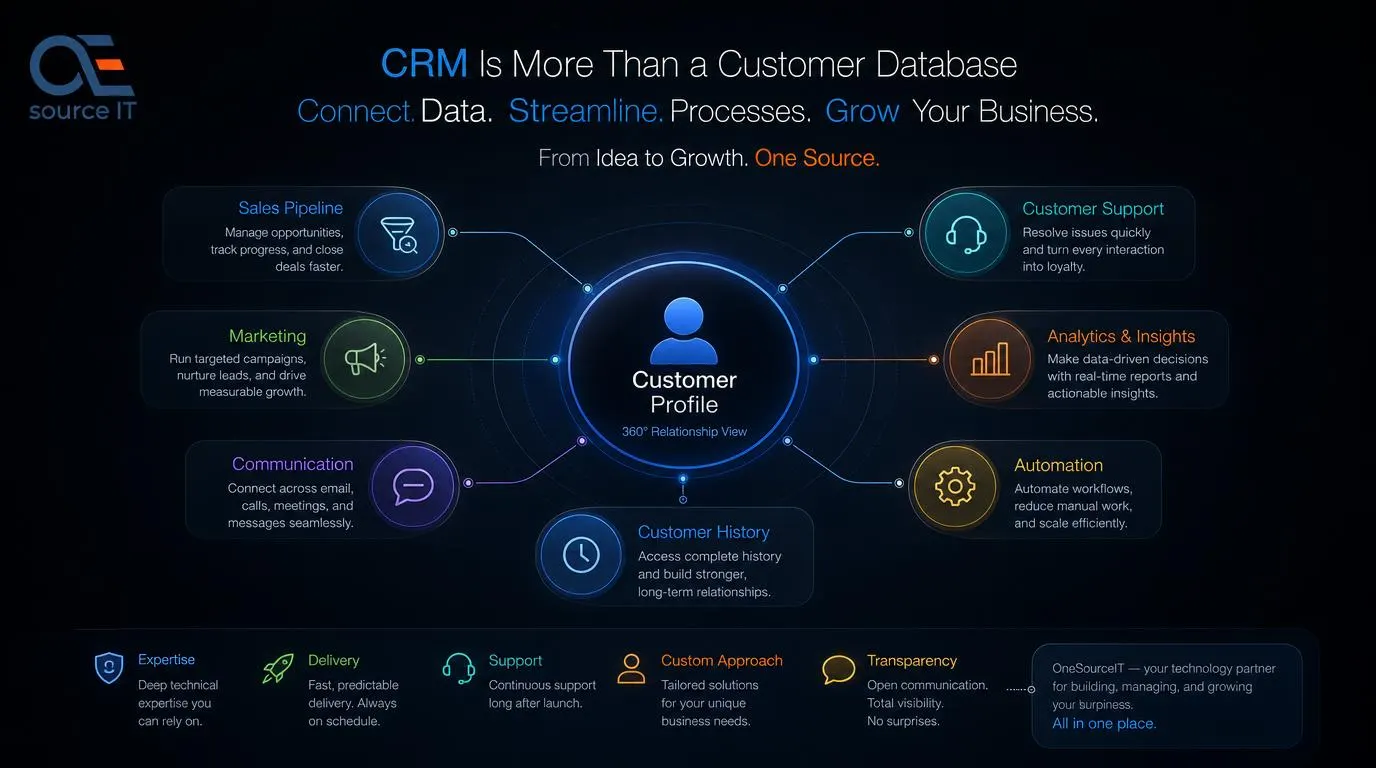
A CRM Is More Than a List of Contacts
Many businesses initially see a CRM as a digital address book — a system for storing customer names, phone numbers, email addresses, and other contact details.
But modern CRM systems can do much more.
A well-designed CRM can connect the entire customer journey — from the first interaction with a potential customer to the development of a long-term business relationship.
Instead of keeping customer information across spreadsheets, emails, messaging platforms, and separate systems, a CRM can bring important information together in one place.
Connecting the Customer Journey
A customer journey usually involves many different stages.
A potential customer may first discover a business through a website, social media, advertising, a recommendation, or a direct inquiry.
From there, the journey can continue through:
Lead generation
Qualification
Sales communication
Proposal or quotation
Negotiation
Purchase
Follow-up
Customer support
Repeat business
Without a connected system, information can easily become fragmented.
A CRM helps businesses organize these stages and create a clearer view of where every customer or lead is in the process.
What Can a CRM Help Businesses Manage?
A CRM can support many areas of day-to-day business operations.
Lead Management
Businesses can capture and organize leads, assign them to responsible employees, track their status, and make sure potential opportunities are not forgotten.
Sales Pipeline
A CRM can provide a visual overview of the sales process — showing which opportunities are new, which are being negotiated, and which are close to becoming customers.
This helps sales teams understand what is happening and where attention is needed.
Communication History
Emails, calls, meetings, notes, and other interactions can be connected to a customer profile.
Instead of searching through different platforms to understand what happened previously, employees can access the relevant communication history in one place.
Automated Follow-Ups
Not every lead is ready to buy immediately.
CRM automation can help schedule reminders, trigger follow-up actions, and ensure that important opportunities do not disappear simply because someone forgot to contact a customer.
Sales and Marketing Alignment
A CRM can connect marketing activity with sales results.
Businesses can understand where leads are coming from, which campaigns generate opportunities, and how marketing efforts contribute to revenue.
Customer Data Management
A centralized CRM can provide a structured view of customer information, making it easier to maintain accurate and up-to-date records.
Analytics and Reporting
CRM data can also become a source of business intelligence.
Reports can help businesses analyze sales performance, conversion rates, lead sources, customer activity, and other important metrics.
The Value Is Not in the Amount of Data
A CRM can store thousands of customer records.
But simply having more data does not automatically create more value.
The real value comes from what a business can do with that information.
A useful CRM should help answer questions such as:
Which leads are most valuable?
Where are opportunities being lost?
Which sales stages take the most time?
Which marketing channels generate the best leads?
Which customers are most active?
When should the sales team follow up?
What should we do next?
This is where CRM moves beyond being a database and becomes a business tool.
From Data to Processes
The strongest CRM implementations do not simply collect information.
They connect information with business processes.
For example, when a new lead enters the system, a CRM can automatically:
Create the lead profile.
Assign it to a sales representative.
Record the source of the lead.
Create a follow-up task.
Send a confirmation message.
Track the lead through the sales pipeline.
Record the final outcome.
The result is a more consistent and measurable process.
CRM Should Adapt to the Business
Every business has different workflows, sales cycles, customer relationships, and operational requirements.
That means a CRM should not always be treated as a one-size-fits-all product.
Depending on the business, CRM solutions can be integrated with:
Websites
Forms
Email
Marketing platforms
Accounting systems
Call centers
Messaging platforms
E-commerce platforms
Analytics tools
Internal business systems
With the right architecture, a CRM can become part of a broader digital ecosystem rather than another isolated application.
Better Processes Lead to Better Decisions
When customer data, business processes, and analytics are connected, businesses can move from assumptions to measurable insights.
The goal is not simply to know what happened.
The goal is to understand what happened, why it happened, and what should happen next.
That is where CRM creates real business value.
Data → Processes → Better Decisions.
CRM as a Business Growth Platform
A CRM can help businesses become more organized, improve customer relationships, reduce manual work, increase sales visibility, and make better use of their data.
But successful CRM implementation is not only about choosing software.
It is about understanding the business process first, designing the right workflows, integrating the necessary systems, and creating a solution that supports the way the business actually operates.
At One Source IT, we help businesses design and implement digital solutions that connect CRM, automation, websites, analytics, and other business systems into a unified digital environment.
Because CRM is not just about storing customer data.
It is about turning that data into better processes, better customer experiences, and better business decisions.
Data → Processes → Better Decisions.
Comments
No comments yet. Be the first to comment!
Leave a comment