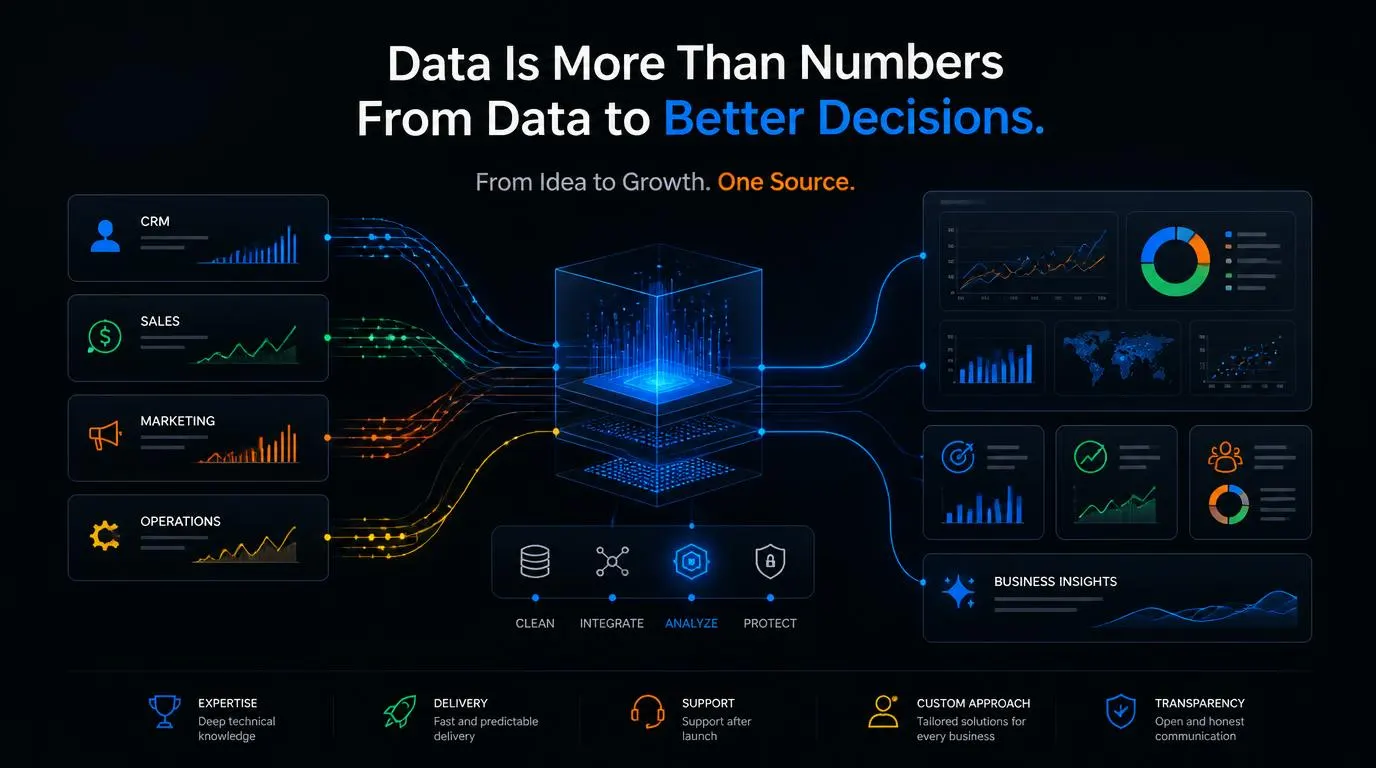
Every business generates data every day.
Sales.
Customers.
Marketing.
Operations.
Finance.
Website activity.
Customer support.
Internal processes.
Modern businesses can collect enormous amounts of information from different systems and digital channels.
But having data does not automatically mean having insight.
The real value of data begins when a business can understand what that data is telling it — and use that understanding to make better decisions.
Data is more than just numbers.
From data collection to understanding
Many businesses already collect data.
A CRM contains customer information.
Analytics platforms track website activity.
Marketing platforms measure campaigns.
Sales systems record transactions.
Financial systems store revenue and expenses.
Operational systems generate information about processes and performance.
The challenge is turning all of this information into something useful.
A report can tell you that sales decreased by 15%.
But that is only the beginning.
The more important questions are:
Why did sales decrease?
Was there a change in demand?
Did the number of leads decline?
Did a marketing campaign perform poorly?
Did the conversion rate change?
Did customers move to another product or service?
And most importantly:
What should the business do next?
This is where Data & Analytics becomes valuable.
What can Data & Analytics help businesses understand?
The right analytics approach can help businesses see patterns and relationships that are difficult to identify from individual numbers.
Identify important trends
Data can reveal changes in sales, customer behavior, demand, website activity, or operational performance over time.
Understanding these trends can help businesses recognize opportunities and potential risks earlier.
Understand customers better
Customer data can provide insight into who customers are, what they need, how they interact with the business, and what influences their decisions.
This can help businesses improve products, services, communication, and customer experience.
Measure business and marketing performance
Businesses need to know whether their activities are producing results.
Analytics can help measure website performance, campaign results, lead generation, conversion rates, sales performance, customer acquisition, and other important metrics.
Detect problems and inefficiencies
Data can reveal where processes are slowing down, where costs are increasing, where customers are dropping out, or where resources are not being used effectively.
Identifying these problems is the first step toward improving them.
Discover growth opportunities
Data can reveal new opportunities that may not be obvious from day-to-day operations.
A particular customer segment may be growing faster.
A specific service may have increasing demand.
A marketing channel may generate better-quality leads.
A particular market may show strong potential.
Analytics can help identify these signals.
Good analytics connects different parts of the business
One of the biggest advantages of modern analytics is the ability to connect information from different areas.
Sales data can be compared with marketing data.
Customer data can be connected with website behavior.
Operational data can be compared with financial performance.
CRM information can be combined with customer support data.
Instead of looking at isolated numbers, businesses can develop a more complete picture of what is happening.
For example:
Marketing → Leads → Sales → Customers → Revenue
When these stages are connected, a business can understand not only how many leads a campaign generated, but also how many became customers and what business value they ultimately created.
This creates a much more meaningful view of performance.
Data should answer questions
Analytics should not exist simply because a business has access to dashboards.
The goal is not to collect as many metrics as possible.
The goal is to answer important business questions.
For example:
Which marketing channels generate the best leads?
Which products generate the highest revenue?
Where are customers dropping out of the sales process?
Which customer segments are growing?
Which operational processes take the most time?
Where are costs increasing?
Which services have the strongest demand?
What is changing over time?
The right data strategy starts with the right questions.
From “what happened?” to “what should we do?”
Basic reporting often answers:
What happened?
Advanced analytics can go further.
Why did it happen?
And eventually:
What should we do next?
This progression is important.
Knowing that website traffic decreased is useful.
Understanding why traffic decreased is more valuable.
Knowing which actions could improve traffic is even more valuable.
The purpose of analytics is not simply to describe the past.
It is to help businesses make better decisions about the future.
Data quality matters
Analytics is only as reliable as the data behind it.
If information is incomplete, duplicated, outdated, inconsistent, or incorrectly collected, the resulting analysis can be misleading.
That is why an effective data strategy should consider:
Data quality
Data integration
Data security
Data governance
Consistent measurement
Reliable reporting
Appropriate access controls
Good analytics starts with trustworthy data.
Make data part of the decision-making process
Data should not belong only to the analytics or IT team.
Business leaders, marketers, sales teams, operations, finance, and other departments can all benefit from having access to relevant information.
When data becomes part of everyday decision-making, businesses can move from assumptions toward evidence.
Instead of asking:
"What do we think is happening?"
Teams can ask:
"What does the data show?"
And then:
"What should we do about it?"
Turning data into business value
The goal of Data & Analytics is not to create more dashboards.
It is to create better understanding.
Better understanding can lead to better decisions.
Better decisions can lead to better processes, stronger customer experiences, more efficient operations, and sustainable business growth.
At One Source IT, we help businesses turn data into useful business insight through analytics, reporting, data integration, business intelligence, and digital solutions designed around real business needs.
Because data becomes valuable when it helps a business understand what is happening, why it is happening, and what to do next.
Data is more than just numbers.
It is a foundation for better decisions and smarter growth.
Comments
No comments yet. Be the first to comment!
Leave a comment