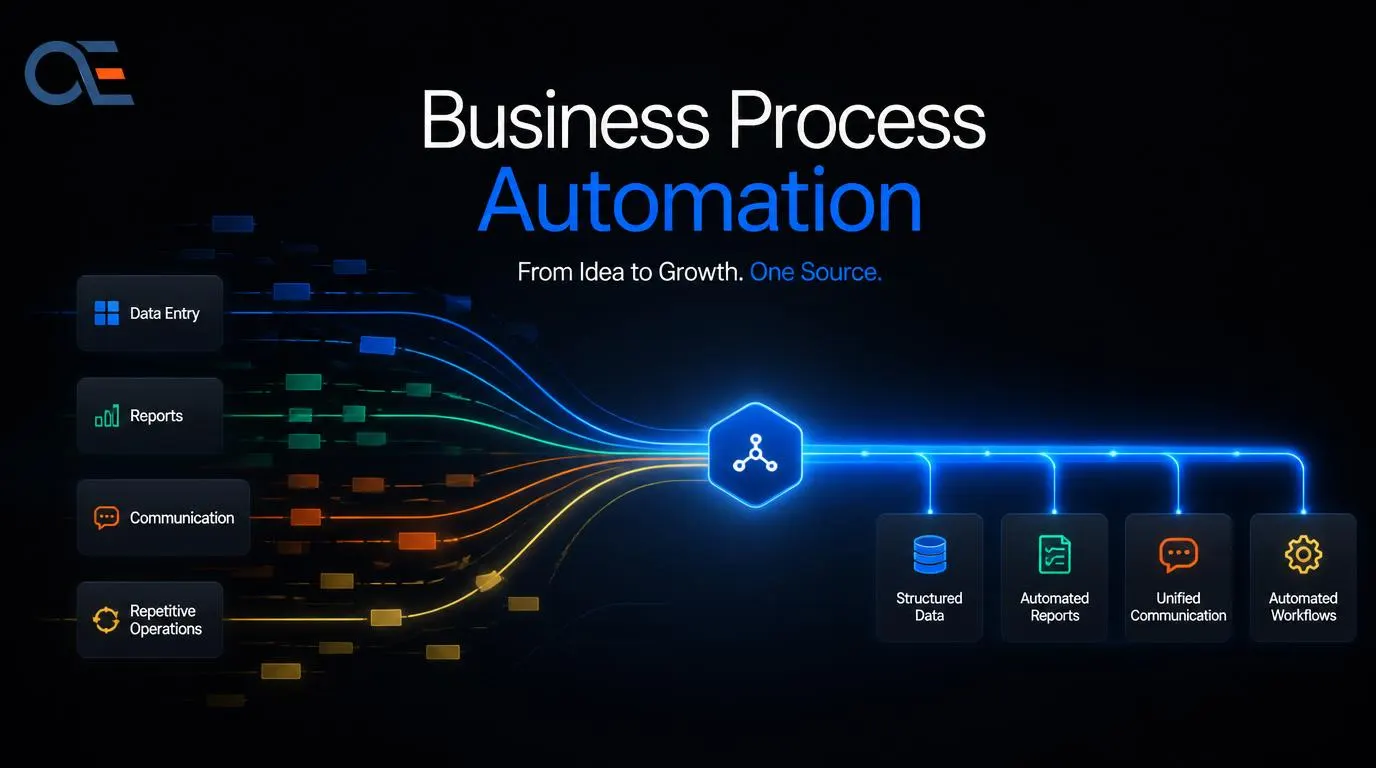
In many businesses, valuable employee time is spent on repetitive tasks that require little strategic thinking.
Data entry.
Emails.
Reports.
Follow-ups.
Copying information between systems.
Updating spreadsheets.
Processing routine requests.
Individually, these tasks may seem small. But when they are repeated every day across a team, they can consume hundreds of hours and create unnecessary operational costs.
This is where business automation can make a significant difference.
What is business automation?
Business automation is the use of technology to execute repetitive business processes with minimal manual intervention.
Instead of requiring employees to perform the same action again and again, an automated workflow can handle the routine steps based on predefined rules.
For example, when a new customer submits a website form, an automated workflow could:
Create a customer record in the CRM
Notify the responsible employee
Send a confirmation email
Create a follow-up task
Update the sales pipeline
Store the submitted information in the appropriate system
The employee does not need to manually perform every step.
What can be automated?
Automation can be applied to many areas of a business.
Data entry and synchronization
Information often needs to be entered into multiple systems. Automation can transfer and synchronize data between platforms, reducing duplicate work and minimizing manual errors.
Email and notifications
Routine emails, internal notifications, reminders, and status updates can often be triggered automatically based on specific events or conditions.
Reports
Regular operational reports can be generated and distributed automatically, allowing teams and managers to access relevant information without manually collecting and processing data.
Customer follow-ups
CRM automation can create reminders, trigger follow-up messages, and move leads through predefined stages of a sales process.
Internal workflows
Approvals, task assignments, document processing, employee requests, and other internal processes can be structured into automated workflows.
Why automate repetitive processes?
Effective automation can provide several practical benefits.
Save time
Employees spend less time performing routine operations and more time working on tasks that require experience, communication, creativity, and decision-making.
Reduce errors
Manual data entry and repetitive operations can introduce mistakes. Automation can make processes more consistent and predictable.
Speed up processes
Automated workflows can execute tasks immediately after a predefined event occurs, reducing unnecessary delays.
Improve operational efficiency
When business processes are clearly structured and automated, teams can work with greater consistency and visibility.
Create better scalability
As a business grows, the number of customers, transactions, requests, and internal processes usually increases. Automation can help businesses handle higher volumes without increasing manual workload at the same rate.
Automation is not about replacing people
One of the most important things to understand about business automation is that its purpose is not necessarily to replace employees.
The goal is to reduce repetitive work.
People should be able to spend more time on activities where human judgment and expertise create value: solving problems, communicating with customers, developing strategies, improving products, and growing the business.
Automation handles the repetitive.
People focus on the important.
Start with the process, not the technology
Successful automation begins with understanding how a business actually operates.
Before introducing an automation solution, it is important to identify:
Which processes are repetitive?
Which tasks consume the most employee time?
Where do errors occur frequently?
Which systems need to exchange information?
Where are employees manually copying or transferring data?
Which processes create delays for customers or teams?
Once these areas are identified, the business can determine which processes should be automated and what technology is appropriate.
Automation can involve CRM systems, APIs, custom software, workflow platforms, integrations, AI solutions, or a combination of different technologies.
Build a more efficient business
Business automation does not have to begin with a large transformation project.
Sometimes a single automated workflow can eliminate hours of repetitive work every week.
The important step is to identify where manual processes are slowing the business down and design a reliable digital workflow around them.
At One Source IT, we help businesses identify opportunities for automation and build technology solutions that connect systems, streamline workflows, and reduce repetitive operational work.
Automate the repetitive. Focus on growth.
Comments
No comments yet. Be the first to comment!
Leave a comment